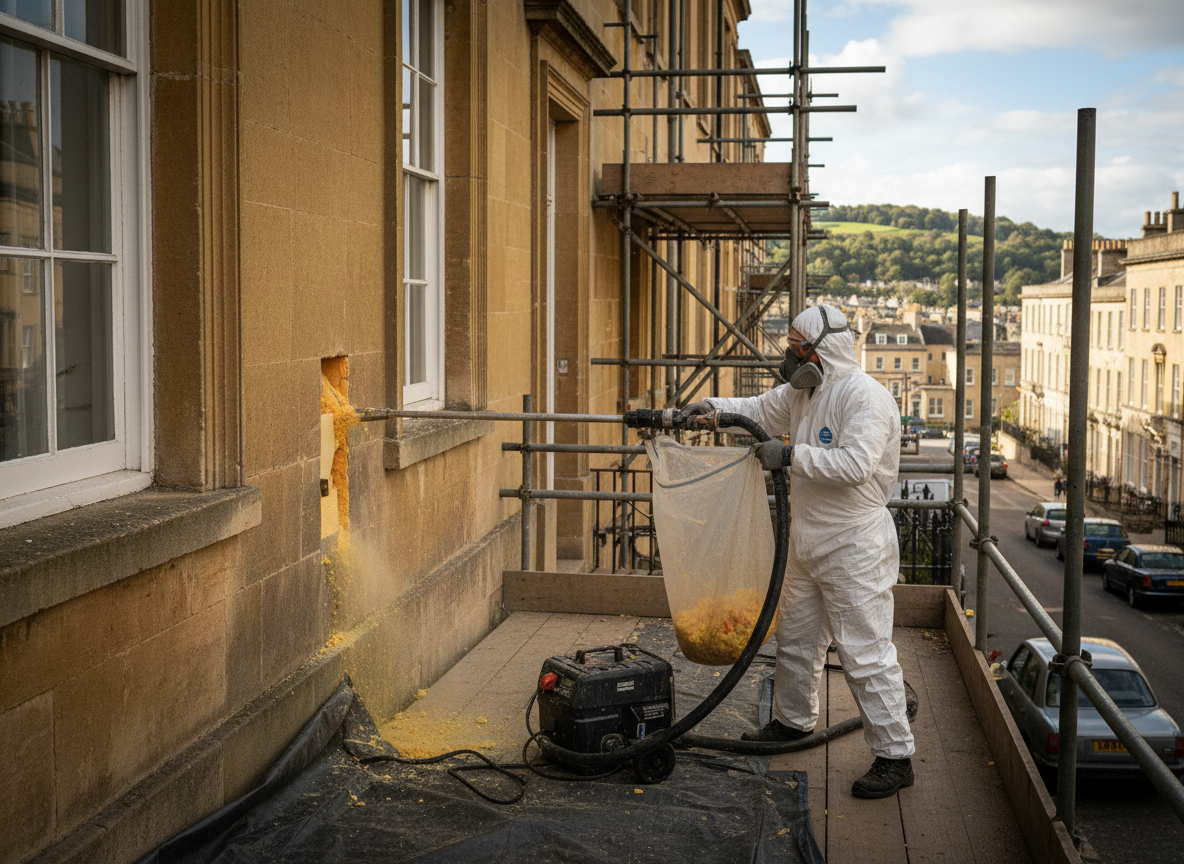
Bath's older housing stock, particularly Georgian and Victorian terraces built with solid stone or cavity brick walls, often received spray foam insulation in the 1970s and 1980s. Over time this closed-cell material traps moisture against the masonry, leading to damp patches on internal walls and accelerated stone decay in properties around areas like Widcombe and Walcot. Removal requires mechanical extraction combined with targeted vacuuming to clear residue from the cavity without disturbing the original pointing or lintels.
Weather patterns in the Bath area, with frequent winter rainfall and high humidity, make foam removal jobs more complex than in drier regions. Water ingress through failed pointing on exposed elevations can saturate the foam, turning a straightforward extraction into a multi-day process that includes drying the cavity before any new insulation is considered. Technicians must also account for the sloping terrain around Lyncombe and Bear Flat, where access to rear elevations is often restricted by retaining walls and narrow passages.
Edge cases frequently arise in listed buildings near the city centre where planning restrictions limit the tools and methods permitted. Homeowners sometimes discover that foam has migrated into roof voids or around window frames, requiring additional inspection points cut from inside the property. Post-removal, cavities are left ventilated to allow natural drying, and any affected timber joists are assessed for rot before handover.
Technician insight
In Bath, the thing that catches most people out with Cavity wall spray foam removal is how quickly moisture builds up behind the foam in stone walls once winter temperatures drop. Georgian and Victorian properties around the centre often have uneven cavities that let water sit against the inner leaf, so extraction has to be followed by proper drying time or the damp simply returns.
Foam Removal in a Walcot Terrace
A homeowner in a mid-terrace property near Walcot reported persistent damp on the rear wall after recent heavy rain. Inspection showed closed-cell foam filling the cavity and holding water against the stone. We extracted the foam mechanically, ventilated the cavity for several days, and confirmed the masonry had begun to dry before leaving the site.
How it works
- 1
Initial Cavity Inspection
Borescope survey through existing weep holes or small access points to map foam distribution and identify any moisture trapped behind the material.
- 2
Targeted Extraction
Mechanical removal of foam using specialist tools that minimise vibration to protect historic stone and brickwork typical of Bath terraces.
- 3
Cavity Cleaning and Drying
Vacuum extraction of residue followed by forced ventilation to remove remaining moisture before the property is returned to the owner.
- 4
Final Verification
Second inspection to confirm the cavity is clear and any damp-related damage has been documented for the homeowner's records.
Pricing
Cost depends on property age, cavity depth and access restrictions common in Bath; upfront quotes provided after inspection.