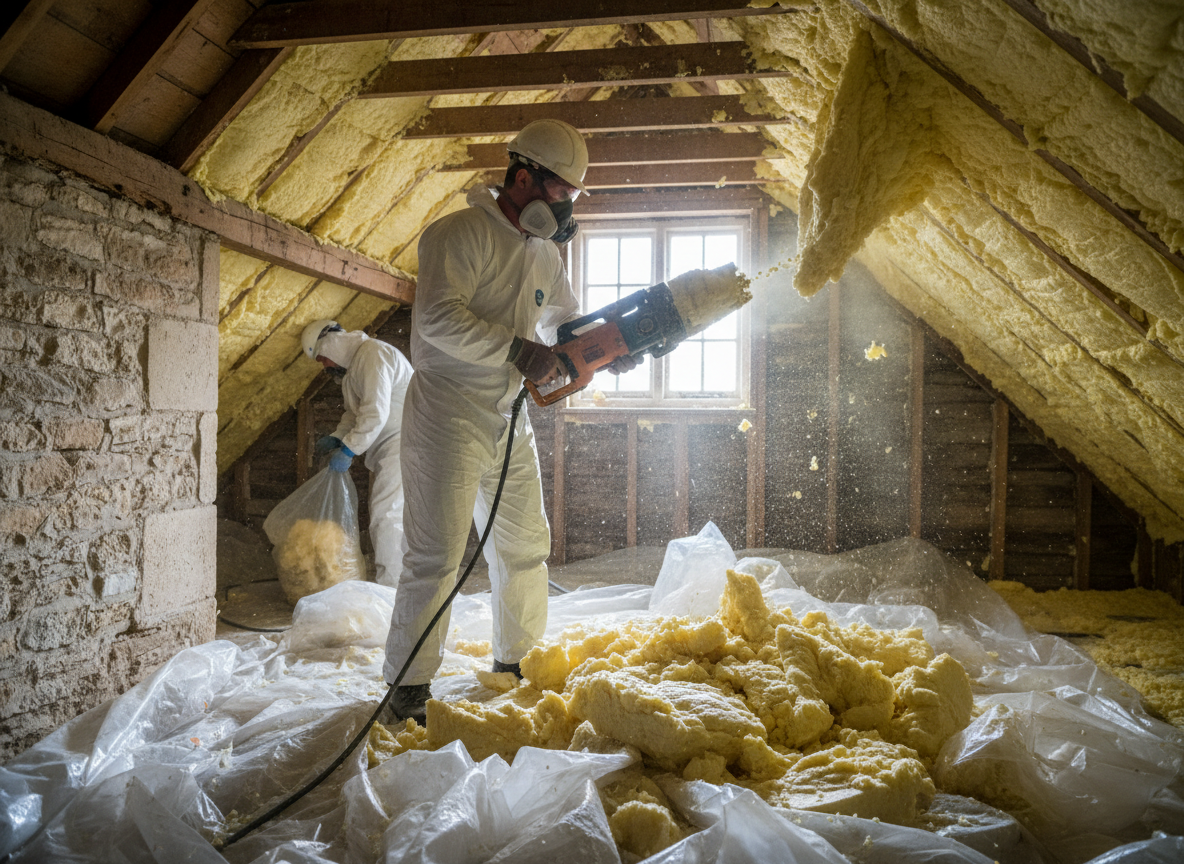
Bath's Georgian and Victorian housing stock often features thick stone walls and timber joists where spray foam was applied decades ago to combat heat loss. Removing it requires careful scoring and peeling to avoid gouging the substrate or releasing fibres into living spaces. Winter damp in the Avon valley can trap moisture behind the foam, leading to hidden rot that only appears once the material is stripped back.
Homeowners in areas such as Widcombe and Larkhall frequently discover foam that has bonded directly to original lath and plaster ceilings. Attempting DIY removal risks damaging irreplaceable cornices or dislodging dust into downstairs rooms. Professional crews use negative-air machines and sealed chutes to contain debris while working around tight roof voids common in these terraced properties.
Somerset planning rules around listed buildings add another layer: any visible damage during removal must be made good to match existing finishes. Teams based at Cambridge House on Henry Street operate 24/7 so urgent jobs in occupied homes can start the same day without disturbing neighbours.
Soil conditions around the lower city can also affect ground-floor installations where foam meets rising damp. Extraction here includes checking for salt migration in the stone before resealing, preventing repeat problems after the new insulation is fitted.
Technician insight
In Bath, the thing that catches most people out with Residential Spray Foam Removal is how often foam was sprayed straight onto the irregular backs of Georgian stone walls in properties like those around the Circus or Royal Crescent; once moisture from the valley winters gets behind it the foam bonds so tightly that pulling it free without scarring the stone takes far longer than homeowners expect.
Loft Clearance in a Widcombe Terrace
Foam in the loft of a 19th-century terrace had trapped condensation against the rafters. Inspection revealed early rot along several joist ends. The team removed the foam in sections, treated the timber, and ventilated the void before resealing. The owners avoided a larger structural repair and could proceed with new insulation suited to the stone walls.
How it works
- 1
Site Assessment
Survey the loft, walls and any concealed voids in the Bath property to map foam depth and substrate condition.
- 2
Containment Setup
Install dust barriers and negative-air filtration to protect living areas from debris during extraction.
- 3
Foam Extraction
Score and peel the foam in controlled sections, working around joists and historic stonework without causing damage.
- 4
Substrate Inspection and Cleanup
Check for rot or damp, vacuum residues, and dispose of waste according to local Somerset regulations.
- 5
Final Verification
Walk the homeowner through the cleared spaces and discuss options for replacement insulation suited to the building's age.
Pricing
Cost varies with property age, foam thickness and access difficulty in Bath stone buildings; quotes are provided after inspection.