Bath's housing stock includes many Georgian and Victorian terraces with thick stone walls and original lath and plaster finishes. Spray foam applied directly to these surfaces often traps moisture against the masonry, leading to hidden rot in timber joists and accelerated deterioration of internal finishes. Removal requires careful separation of the foam without disturbing the underlying structure, especially in properties around areas such as Walcot, Bear Flat and Oldfield Park where access is frequently restricted by narrow stairwells and listed features.
Seasonal rainfall in the Bath area means properties can experience prolonged damp periods that interact badly with closed-cell foam. Once removal begins, crews commonly find water staining and mould growth that must be addressed before any new insulation is considered. Work in these conditions includes temporary ventilation measures and monitoring of humidity levels to prevent further damage to ceilings and party walls shared with neighbouring homes.
Edge cases in the Bath area include foam that has been applied over electrical cabling or within roof voids containing original timber trusses. Safe removal demands isolation of services and incremental cutting to avoid pulling down historic plasterwork. Homeowners in the city centre and surrounding villages often discover that partial removal leaves residue that continues to off-gas, requiring a full clean-back to the substrate before the space can be reoccupied safely.
Technician insight
In Bath, the thing that catches most people out with Spray Foam Removal near me is how quickly moisture builds behind the foam on north-facing stone walls in terraces around Larkhall and Widcombe. The local limestone holds water longer than brick, so hidden rot in joist ends often appears only after the foam comes off.
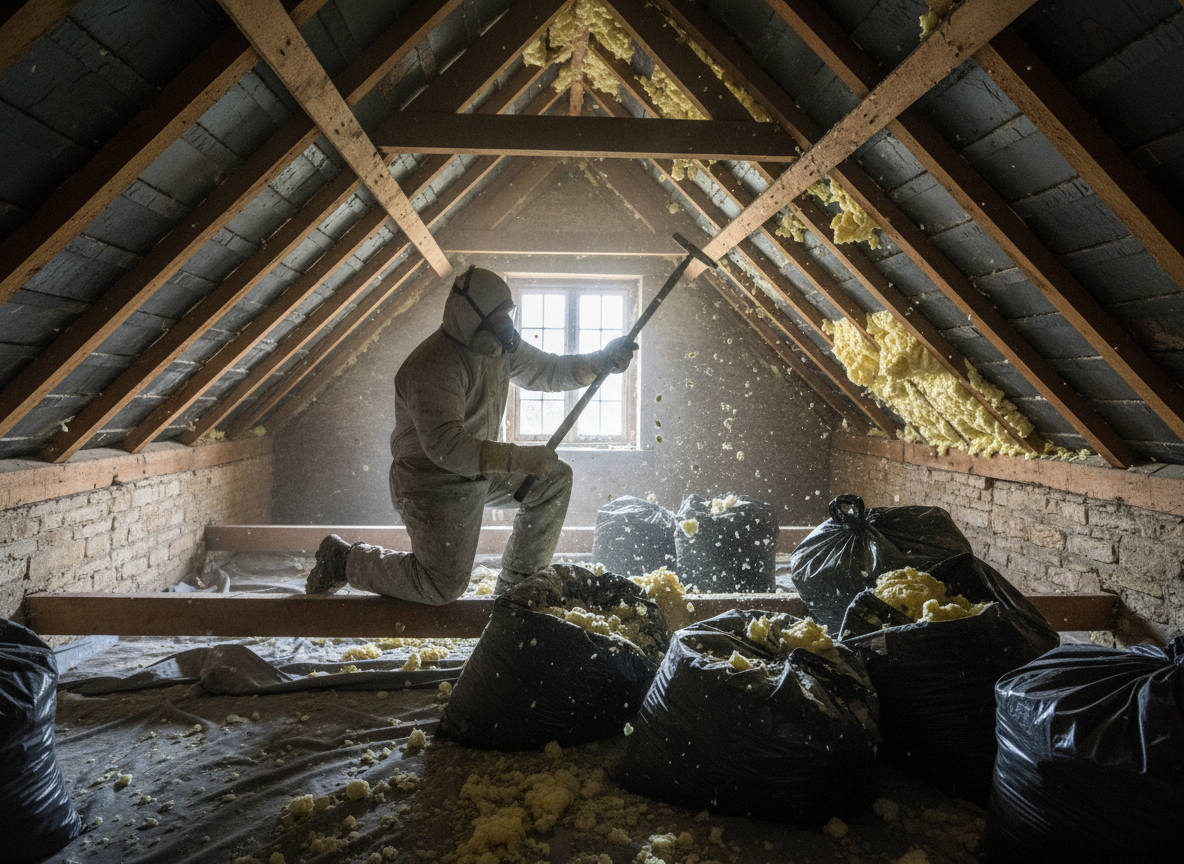
Foam Stripped from a Walcot Terrace Loft
Homeowner reported musty smells in the top floor of a mid-terrace property. Inspection revealed closed-cell foam covering rafters and trapping condensation against the stone gable. Crew removed the foam in sections, exposed damp timber and installed temporary ventilation. The space dried out without further damage to the original roof structure.
How it works
- 1
Initial Assessment
Inspect the property to map foam locations, check for hidden moisture and identify access constraints typical of Bath stone buildings.
- 2
Site Preparation
Protect floors, electrics and adjacent rooms, then establish containment to manage dust and debris during removal.
- 3
Foam Extraction
Use mechanical and manual methods to strip foam layer by layer, monitoring for any impact on original lath, plaster or timber.
- 4
Cleanup and Verification
Remove residue, ventilate the space and conduct a final check for remaining material or moisture issues before handover.
Pricing
Pricing depends on property age, foam depth and access difficulty; upfront quotes are provided after inspection.