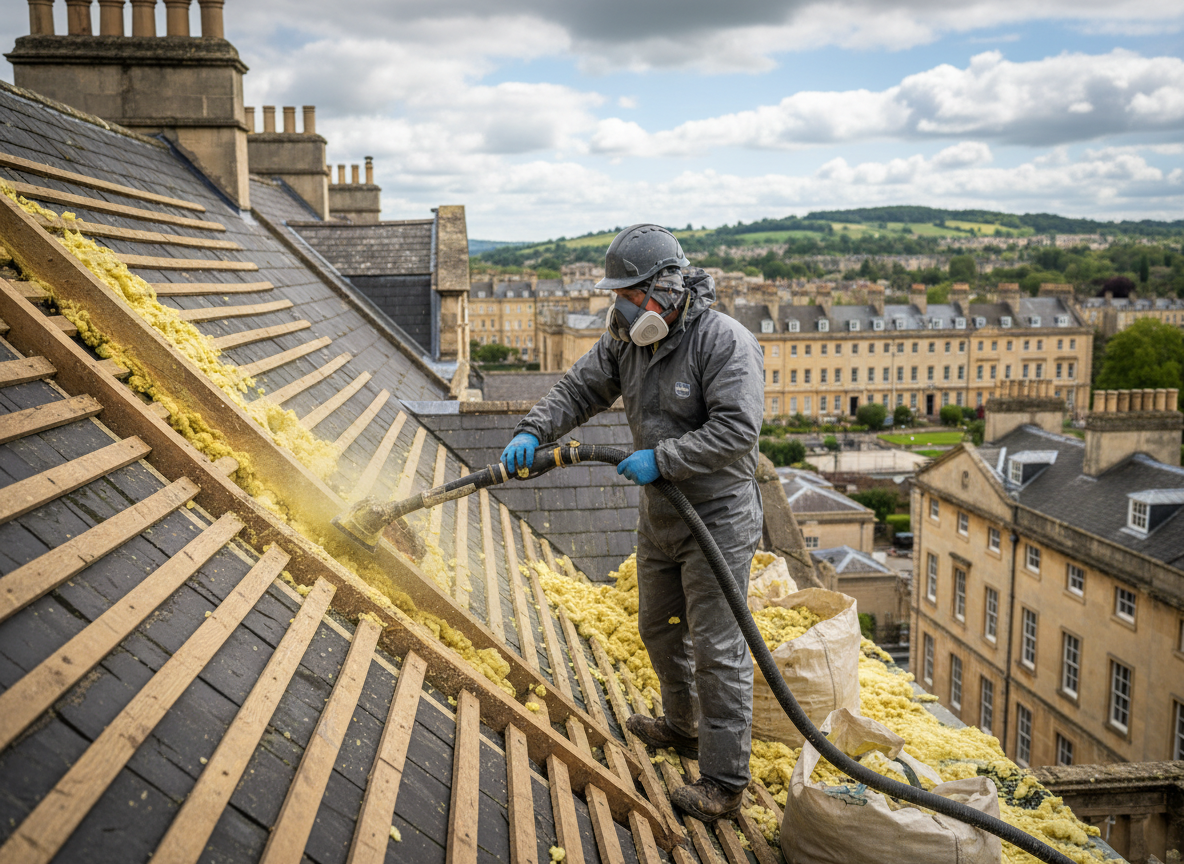
Bath's Georgian and Victorian housing stock often received spray foam insulation in the 1980s and 1990s to improve energy efficiency on pitched roofs. Over time the closed-cell material bonds tightly to stone tiles and timber rafters, creating a vapour barrier that prevents the breathable construction from drying after rain. Removal requires careful mechanical scraping and solvent softening to avoid cracking the fragile Bath stone or dislodging original pegged joints.
The local climate brings frequent driving rain and high humidity, especially on north-facing slopes in areas such as Walcot and Bathwick. Foam that has absorbed moisture becomes heavier and more difficult to section without dropping debris into ceilings below. Technicians must work in short weather windows and use temporary ridge protection to keep the exposed roof watertight overnight.
Edge cases include foam applied over original torching or between rafters that have since twisted. In these situations full removal can reveal rot that must be treated before any new insulation is considered. Work is carried out from the loft where possible to minimise external scaffolding on narrow city-centre streets.
Technician insight
In Bath the thing that catches most people out with roof spray foam removal is how the stone-tiled roofs on Georgian terraces hold rainwater against the foam for weeks after a storm, turning the back of the foam into a wet sponge that hides rot until you start pulling it off.
Hidden rot behind foam in a Lansdown terrace
Homeowner in Lansdown noticed musty smell after winter storms. Inspection revealed closed-cell foam bonded to rafters and trapping water against the stone tiles. We removed the foam in sections, treated the affected timber and left the roof void ventilated so the structure could dry naturally.
How it works
- 1
Site Assessment
Inspect roof structure, foam depth and any signs of trapped moisture from inside the loft and from external vantage points.
- 2
Protection Setup
Install dust sheeting, temporary ridge covers and safe access routes to protect interiors and neighbouring properties.
- 3
Foam Extraction
Cut and lift foam in manageable sections using hand tools and low-solvent softeners to limit damage to historic timbers and stone.
- 4
Clearance and Inspection
Remove all residue, vacuum debris and inspect rafters for rot or water staining before handing back a clean roof void.
Pricing
Price depends on roof pitch, foam thickness and access restrictions common in Bath's terraced and listed buildings; site visit required for accurate quote.